Should You Correct Your Child's Mistakes in a Second Language?
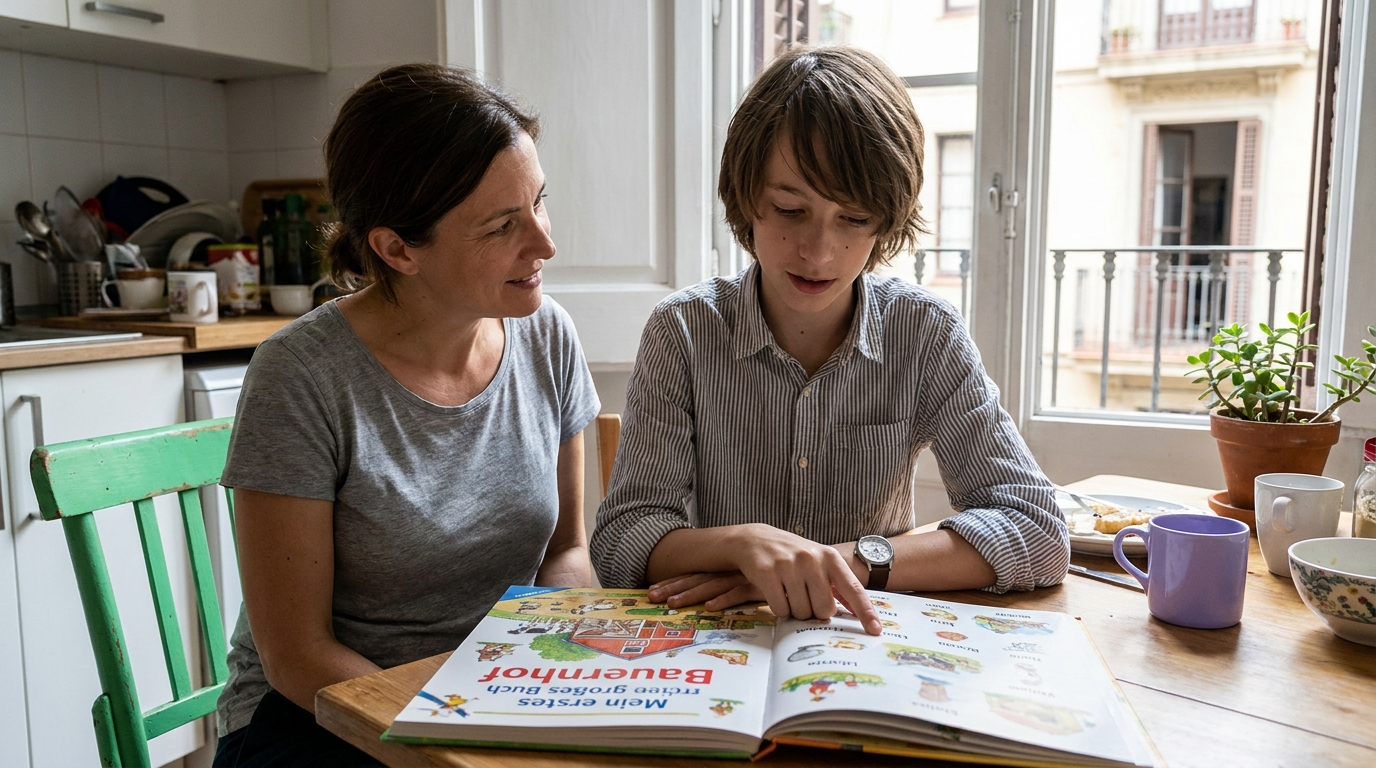
When your child makes a grammar mistake in German or English, the most effective thing you can do is not correct them directly. Instead, simply repeat what they said — using the right form, naturally, as part of the conversation. This technique mirrors exactly how children acquire their first language, and it works just as well for a second one.
Is it bad to correct children when they make mistakes in a second language?
Explicit correction — stopping a child mid-sentence to say "that's wrong, it should be…" — tends to do more harm than good. I've noticed this consistently over more than ten years of teaching children German. The moment a child feels judged for an error, they start speaking less. They hesitate. They self-censor. And silence is the one thing that genuinely slows down language acquisition. Mistakes, on the other hand, are not a problem. They are evidence that the child is actively building their own grammar — testing patterns, taking risks. That is exactly what we want.
How did children learn their first language without being corrected?
Think back to when your child was learning to speak Spanish. You never sat them down and explained grammatical rules. When they said something like "I goed to the park", you didn't mark it as an error — you probably just said "Oh, you went to the park! How fun!" Without realising it, you were using a technique that linguists call recasting: reformulating the child's sentence correctly, in context, without drawing attention to the mistake. The child hears the right form, registers it, and moves on. No shame, no friction.
This is the same methodology that works for a second or third language. The mechanism is identical. What changes is only the language.
What is recasting and how do I use it with my child at home?
Recasting means echoing back your child's utterance in its corrected form, naturally woven into your reply. You are not interrupting them — you are responding to the meaning of what they said, while quietly modelling the correct structure.
Here is a concrete example in German. Your child wants ice cream and says: "Ich möchte den Eis." The article is wrong — Eis is neuter, so it should be das Eis, not den Eis. Instead of stopping to explain German grammatical gender, you simply reply: "Du möchtest das Eis? Hier, bitte!" You've confirmed you heard them, you've used the correct article, and the conversation continues. No awkwardness, no discouragement.
The child's brain notices the difference. Not consciously — that is precisely the point. Implicit learning, repeated over time, is how grammar becomes intuitive rather than memorised.
How often should I recast — won't my child notice I'm correcting them?
Children rarely notice, and that is one of recasting's greatest strengths. Because you are responding to the content of what they said — not flagging the error — the interaction feels like a normal conversation. I've used this approach with hundreds of children, and not one has ever said "Are you correcting me right now?" They feel heard. They feel understood. That sense of being listened to is itself a motivator to keep speaking.
As for frequency: recast naturally, whenever an error occurs in a form the child is developmentally ready to absorb. You don't need to recast every single mistake. If a child is only two months into German, certain errors are completely expected and will resolve on their own. Save your energy for the patterns that are emerging — the ones the child is clearly trying to use but hasn't quite nailed yet.
What mistakes should I simply leave alone?
Not every error deserves a recast. There are three situations where I generally leave a mistake alone:
- The error is developmentally normal for their stage. A child who has been learning German for three months will mix up cases. That is expected. Recasting constantly at this stage can overwhelm rather than guide.
- The child is in the middle of telling you something exciting. If they are genuinely engaged and communicating, interrupting the flow — even gently — can shut down that enthusiasm. Let them finish. You can model the correct form later, in a different context.
- The same error has been recast many times already. If a particular structure keeps appearing incorrectly despite repeated natural exposure, it may need a different approach — perhaps a game, a song, or a structured activity that focuses on that form. But that is a separate conversation from correction in the moment.
What if my child is afraid of making mistakes altogether?
Fear of making mistakes is the single biggest obstacle I see in children learning a second language at home — bigger than vocabulary gaps, bigger than pronunciation difficulties. It usually develops when correction has been too direct, too frequent, or too emotionally loaded. If your child has started avoiding speaking in the target language, or only says things they are certain are correct, that is the signal.
The antidote is to make space for imperfection — explicitly and consistently. Speak the language imperfectly yourself sometimes. Laugh at your own errors. When your child makes a mistake, your body language matters as much as your words: a smile and a natural continuation of the conversation communicates this is fine, keep going more powerfully than any reassurance you could verbalise.
I've seen children who barely said a word in German in October become confident, talkative speakers by March — not because they suddenly learned more grammar, but because they stopped being afraid of the words they already had.
The one thing to remember about correcting children in a second language
Every time you recast a sentence instead of correcting it, you are doing two things at once: teaching the language, and proving to your child that communication matters more than perfection. That second message is the one that keeps children speaking. And a child who keeps speaking — imperfectly, bravely, consistently — will always outpace a child who waits until they are certain they are right.